

5.27: Interior Angles in Convex Polygons
- Page ID
- 5012
\( \newcommand{\vecs}[1]{\overset { \scriptstyle \rightharpoonup} {\mathbf{#1}} } \)
\( \newcommand{\vecd}[1]{\overset{-\!-\!\rightharpoonup}{\vphantom{a}\smash {#1}}} \)
\( \newcommand{\dsum}{\displaystyle\sum\limits} \)
\( \newcommand{\dint}{\displaystyle\int\limits} \)
\( \newcommand{\dlim}{\displaystyle\lim\limits} \)
\( \newcommand{\id}{\mathrm{id}}\) \( \newcommand{\Span}{\mathrm{span}}\)
( \newcommand{\kernel}{\mathrm{null}\,}\) \( \newcommand{\range}{\mathrm{range}\,}\)
\( \newcommand{\RealPart}{\mathrm{Re}}\) \( \newcommand{\ImaginaryPart}{\mathrm{Im}}\)
\( \newcommand{\Argument}{\mathrm{Arg}}\) \( \newcommand{\norm}[1]{\| #1 \|}\)
\( \newcommand{\inner}[2]{\langle #1, #2 \rangle}\)
\( \newcommand{\Span}{\mathrm{span}}\)
\( \newcommand{\id}{\mathrm{id}}\)
\( \newcommand{\Span}{\mathrm{span}}\)
\( \newcommand{\kernel}{\mathrm{null}\,}\)
\( \newcommand{\range}{\mathrm{range}\,}\)
\( \newcommand{\RealPart}{\mathrm{Re}}\)
\( \newcommand{\ImaginaryPart}{\mathrm{Im}}\)
\( \newcommand{\Argument}{\mathrm{Arg}}\)
\( \newcommand{\norm}[1]{\| #1 \|}\)
\( \newcommand{\inner}[2]{\langle #1, #2 \rangle}\)
\( \newcommand{\Span}{\mathrm{span}}\) \( \newcommand{\AA}{\unicode[.8,0]{x212B}}\)
\( \newcommand{\vectorA}[1]{\vec{#1}} % arrow\)
\( \newcommand{\vectorAt}[1]{\vec{\text{#1}}} % arrow\)
\( \newcommand{\vectorB}[1]{\overset { \scriptstyle \rightharpoonup} {\mathbf{#1}} } \)
\( \newcommand{\vectorC}[1]{\textbf{#1}} \)
\( \newcommand{\vectorD}[1]{\overrightarrow{#1}} \)
\( \newcommand{\vectorDt}[1]{\overrightarrow{\text{#1}}} \)
\( \newcommand{\vectE}[1]{\overset{-\!-\!\rightharpoonup}{\vphantom{a}\smash{\mathbf {#1}}}} \)
\( \newcommand{\vecs}[1]{\overset { \scriptstyle \rightharpoonup} {\mathbf{#1}} } \)
\(\newcommand{\longvect}{\overrightarrow}\)
\( \newcommand{\vecd}[1]{\overset{-\!-\!\rightharpoonup}{\vphantom{a}\smash {#1}}} \)
\(\newcommand{\ket}[1]{\left| #1 \right>}\)
\(\newcommand{\bra}[1]{\left< #1 \right|}\)
\(\newcommand{\braket}[2]{\left< #1 \vphantom{#2} \right| \left. #2 \vphantom{#1} \right>}\)
\(\newcommand{\braopket}[3]{\left< #1 \vphantom{#2}\vphantom{#3} \right| #2 \vphantom{#1}\vphantom{#3} \left| #3 \vphantom{#1}\vphantom{#2} \right>}\)
\(\newcommand{\qmvec}[1]{\mathbf{\vec{#1}}}\)
\(\newcommand{\op}[1]{\hat{\mathbf{#1}}}\)
\(\newcommand{\expect}[1]{\langle #1 \rangle}\)
\(\newcommand{\dfn}[1]{\emph{\textbf{#1}}}\)
Use the formula \((x - 2)180\) to find the sum of the interior angles of any polygon.
The interior angle of a polygon is one of the angles on the inside, as shown in the picture below. A polygon has the same number of interior angles as it does sides.
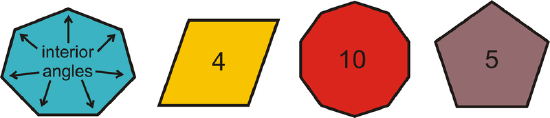
The sum of the interior angles in a polygon depends on the number of sides it has. The Polygon Sum Formula states that for any n−gon, the interior angles add up to \((n−2)\times 180^{\circ}\).
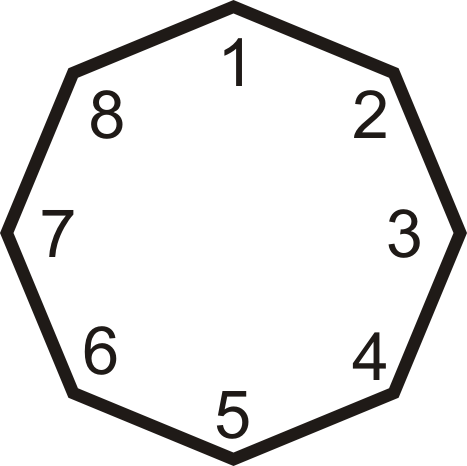
\(\begin{aligned}\rightarrow n=8 \\ (8−2) &\times 180^{\circ} \\ 6 &\times 180^{\circ} \\ &1080^{\circ}\end{aligned}\)
Once you know the sum of the interior angles in a polygon it is easy to find the measure of ONE interior angle if the polygon is regular: all sides are congruent and all angles are congruent. Just divide the sum of the angles by the number of sides.
Regular Polygon Interior Angle Formula: For any equiangular n−gon, the measure of each angle is \(\dfrac{(n−2)\times 180^{\circ}}{n}\).
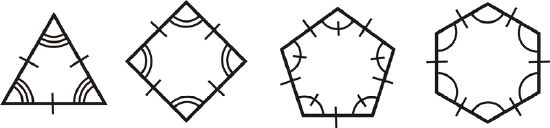
In the picture below, if all eight angles are congruent then each angle is \(\dfrac{(8−2)\times 180^{\circ}}{8}=\dfrac{6\times 180^{\circ}}{8}=\dfrac{1080^{\circ}}{8}=135^{\circ}\).
What if you were given an equiangular seven-sided convex polygon? How could you determine the measure of its interior angles?
Example \(\PageIndex{1}\)
The interior angles of a pentagon are \(x^{\circ}\), \(x^{\circ}\), \(2x^{\circ}\), \(2x^{\circ}\), and \(2x^{\circ}\). What is \(x\)?
Solution
From the Polygon Sum Formula we know that a pentagon has interior angles that sum to \((5−2)\times 180^{\circ}=540^{\circ}\).
Write an equation and solve for x.
\(\begin{aligned} x^{\circ}+x^{\circ}+2x^{\circ}+2x^{\circ}+2x^{\circ}&=540^{\circ} \\ 8x&=540 \\ x&=67.5\end{aligned}\)
Example \(\PageIndex{2}\)
What is the sum of the interior angles in a 100-gon?
Solution
Use the Polygon Sum Formula. \((100−2)\times 180^{\circ}=17,640^{\circ}\).
Example \(\PageIndex{3}\)
The interior angles of a polygon add up to \(1980^{\circ}\). How many sides does it have?
Solution
Use the Polygon Sum Formula and solve for n\).
\(\begin{aligned} (n−2)\times 180^{\circ}&=1980^{\circ} \\ 180^{\circ}n−360^{\circ}&=1980^{\circ} \\ 180^{\circ}n&=2340^{\circ} \\ n&=13\end{aligned}\)
The polygon has 13 sides.
Example \(\PageIndex{4}\)
How many degrees does each angle in an equiangular nonagon have?
Solution
First we need to find the sum of the interior angles; set \(n=9\).
\((9−2)\times 180^{\circ}=7\times 180^{\circ}=1260^{\circ}\)
“Equiangular” tells us every angle is equal. So, each angle is \(\dfrac{1260^{\circ}}{9}=140^{\circ}\).
Example \(\PageIndex{5}\)
An interior angle in a regular polygon is \(135^{\circ}\). How many sides does this polygon have?
Solution
Here, we will set the Regular Polygon Interior Angle Formula equal to \(135^{\circ}\) and solve for n.
\(\begin{aligned} \dfrac{(n−2)\times 180^{\circ}}{n}&=135^{\circ} \\ 180^{\circ}n−360^{\circ}−360^{\circ}&=135^{\circ}n \\ n&=−45^{\circ} \\ n&=8\qquad \text{The polygon is an octagon.} \end{aligned}\)
Review
- Fill in the table.
| # of sides | Sum of the Interior Angles | Measure of Each Interior Angle in a Regular n−gon |
|---|---|---|
| 3 | \(60^{\circ}\) | |
| 4 | \(360^{\circ}\) | |
| 5 | \(540^{\circ}\) | \(108^{\circ}\) |
| 6 | \(120^{\circ}\) | |
| 7 | ||
| 8 | ||
| 9 | ||
| 10 | ||
| 11 | ||
| 12 |
- What is the sum of the angles in a 15-gon?
- What is the sum of the angles in a 23-gon?
- The sum of the interior angles of a polygon is \(4320^{\circ}\). How many sides does the polygon have?
- The sum of the interior angles of a polygon is \(3240^{\circ}\). How many sides does the polygon have?
- What is the measure of each angle in a regular 16-gon?
- What is the measure of each angle in an equiangular 24-gon?
- Each interior angle in a regular polygon is \(156^{\circ}\). How many sides does it have?
- Each interior angle in an equiangular polygon is \(90^{\circ}\). How many sides does it have?
For questions 10-18, find the value of the missing variable(s).
-
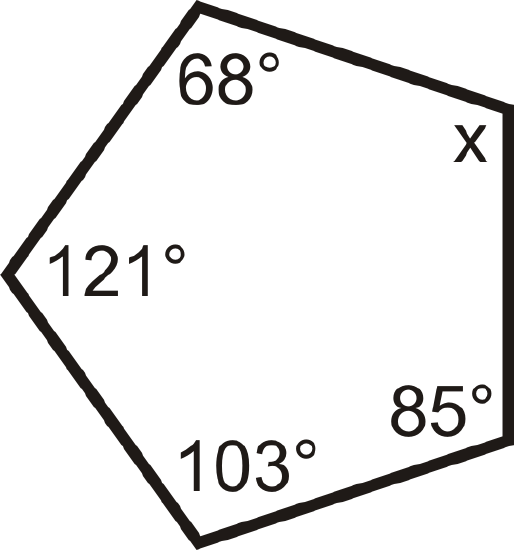
Figure \(\PageIndex{5}\) -
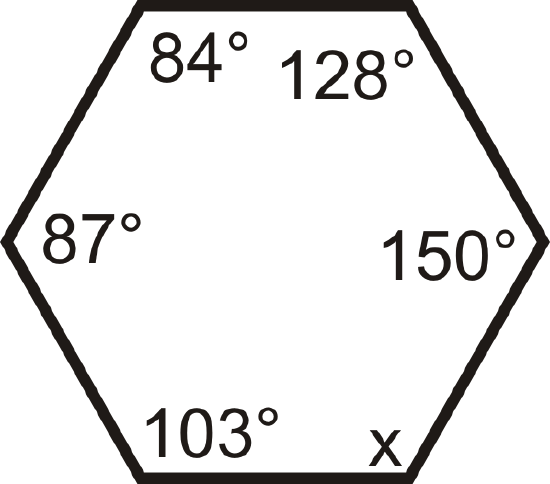
Figure \(\PageIndex{6}\) -
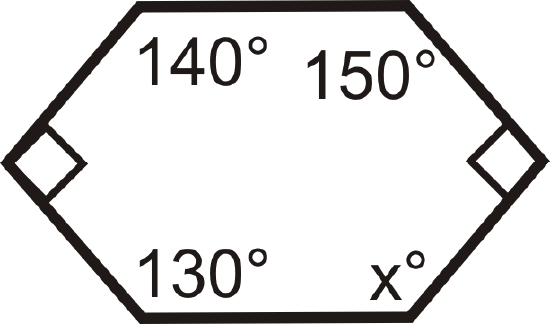
Figure \(\PageIndex{7}\) -
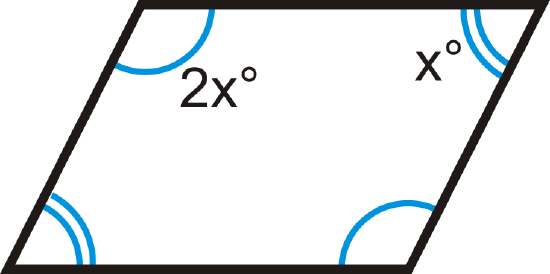
Figure \(\PageIndex{8}\) -
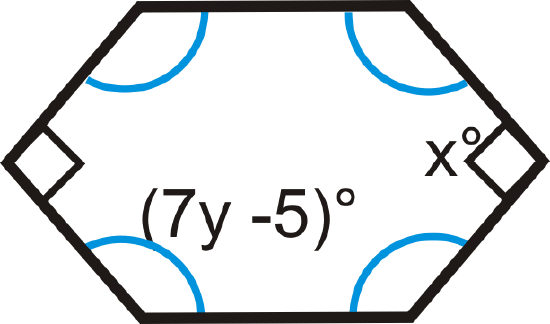
Figure \(\PageIndex{9}\) -
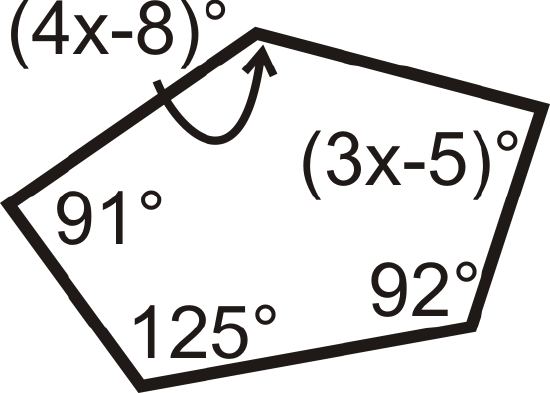
Figure \(\PageIndex{10}\) -
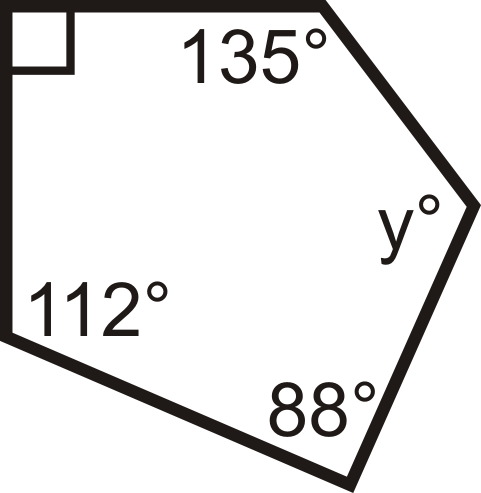
Figure \(\PageIndex{11}\) -
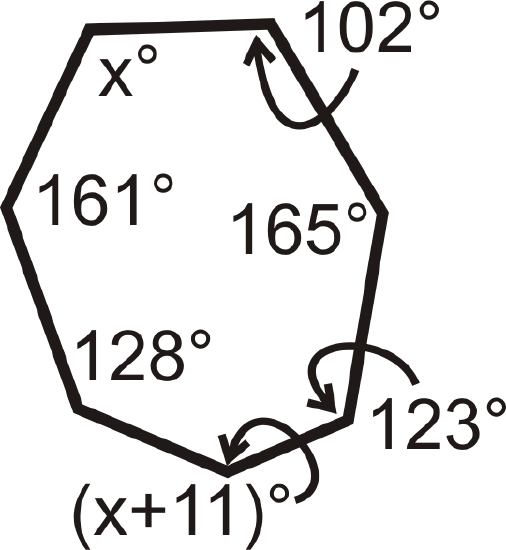
Figure \(\PageIndex{12}\) -
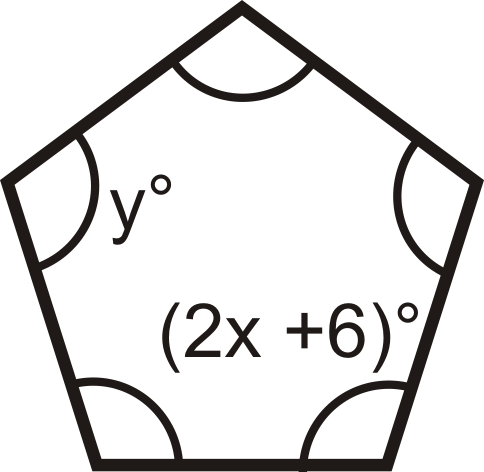
Figure \(\PageIndex{13}\)
- The interior angles of a hexagon are \(x^{\circ}\), \((x+1)^{\circ}\), \((x+2)^{\circ}\), \((x+3)^{\circ}\),\((x+4)^{\circ}\), and \((x+5)^{\circ}\). What is \(x\)?
Review (Answers)
To see the Review answers, open this PDF file and look for section 6.1.
Resources
Vocabulary
| Term | Definition |
|---|---|
| Interior angles | Interior angles are the angles inside a figure. |
| Polygon Sum Formula | The Polygon Sum Formula states that for any polygon with n sides, the interior angles add up to \((n−2)\times 180\) degrees. |
Additional Resources
Interactive Element
Video: Interior and Exterior Angles of a Polygon
Activities: Interior Angles in Convex Polygons Discussion Questions
Study Aids: Polygons Study Guide
Practice: Interior Angles in Convex Polygons
Real World: Interior Angles In Convex Polygons